
Authors

Franziska-J. Klebôn
General Manager - DACH , Clouds on Mars Switzerland

Dr. Estera Kot
Chief Technology Officer , Clouds on Mars GmbH

Sebastian Selman
Data & AI Lead , Clouds on Mars Switzerland
Published on:
October 13, 2026
The Myth of Fast: Why Switzerland's AI Advantage Depends on What It Refuses to Rush
The Myth of Fast: Why Switzerland's AI Advantage Depends on What It Refuses to Rush
Clouds on Mars’ perspective on AI adoption, pace, and what's at stake for Switzerland
Switzerland has a strange relationship with speed. We build the world's most precise watches and then wait forty years for a canton to approve a building permit. We invented some of Europe's most disciplined engineering culture and then spent a decade debating whether to regulate artificial intelligence at all. And now, in the middle of the fastest technology cycle most of us will live through, Switzerland finds itself in a position that should make every executive in this room pause before writing another “AI-first” strategy slide.
We are, by several measures, the most AI-capable country in the world. We are also, by several other measures, one of the most hesitant to actually use it.
That contradiction is not a flaw. It might be our single biggest competitive advantage - if we understand what it actually means, and stop mistaking speed for progress.
The paradox, in numbers
Start with talent. Stanford's 2026 AI Index ranks Switzerland first in the world for AI researchers anddevelopers per capita (110.5 per 100,000, Singapore 109.5, Sweden 80.6, United States 64.8. 43.6% of Swiss AI talent hold PhDs, third globally) a position built over decades of investment in ETH Zurich, EPFL, and a research ecosystem few countries can match. Generative AI adoption among Swiss businesses and workers has climbed steadily, placing the country ahead of the European average and ahead of the United States on usage share.
And yet the same body of research flags something uncomfortable: Swiss startup investment is lagging behind the global and European leaders, even as the talent pipeline keeps producing world-class AI researchers. We are training the engineers who build the future elsewhere.
Zoom into the corporate layer and the picture sharpens further. Roughly two-thirds of Swiss SMEs say they plan to integrate at least one AI tool into their operations - but only a small fraction have anything resembling a structured plan to get there. The gap between intention and execution is where budgets get burned, pilots quietly die, and teams lose faith in a technology they were told would change everything by Q3.
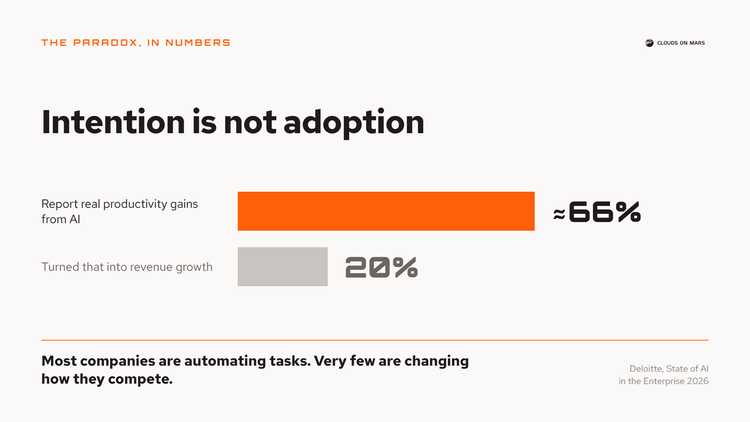
This is just a unique problem for Switzerland, Deloitte's global enterprise research shows the same pattern at scale: two-thirds of organizations report real productivity gains from AI – however, three in four (74%) hope for revenue growth, one in five has it. Most companies, everywhere, are still automating tasks. Very few are transforming how they compete.
Switzerland's version of this story simply has higher stakes, because we are not competing on cost, scale, or speed. We compete on trust. And trust is exactly the thing that gets damaged when “fast” and “responsible” are treated as opposites.
The regulatory bet nobody else made
While the European Union built a single, horizontal AI Act with tiered risk categories and headline fines running into the tens of millions of euros, the Swiss Federal Council chose a different path in 2025: no standalone AI law, but a sector-specific approach layered onto existing legislation - data protection law, healthcare law, transport law - plus ratification of the Council of Europe's AI Convention. A consultation draft implementing that approach is due by the end of 2026.
Critics call this too slow. We would argue it's the more honest position: Switzerland is betting that trust can be built through existing, well-understood legal instruments rather than a brand-new compliance regime - while quietly asking every company operating here to do the governance work anyway, because clients, insurers, and cross-border partners will demand it regardless of what Bern legislates.
Here is the part that gets lost in the regulatory commentary: Swiss companies exporting into the EU still need to meet EU AI Act conformity requirements. “We don't have to comply yet” is not a strategy. It's a countdown.
The companies that will win the next three years in this market are not the ones waiting for the law to tell them what governance looks like. They're the ones already building it - quality management systems aligned to standards like ISO/IEC 42001, documented model risk processes, and human-oversight structures - because that is what enterprise procurement, cyber insurers, and increasingly cautious boards are already asking for, regulation or not.
Sovereignty stopped being a theoretical debate
For years, “AI sovereignty” was a slide in a government strategy deck. In 2026, it became operational reality - twice.
First, the constructive version: EPFL, ETH Zurich, and the Swiss National Supercomputing Centre released Apertus, a fully open, multilingual large language model trained on Switzerland's own Alps supercomputer, with training data, code, and alignment process published in full. Swisscom now runs it on a sovereign platform designed for organisations that cannot afford to have their data - or their model access - depend entirely on a foreign vendor's terms of service. Microsoft, for its part, has committed USD 400 million to upgrading its Swiss data centre infrastructure specifically so that AI workloads for regulated sectors like finance, healthcare, and government can stay on Swiss soil.
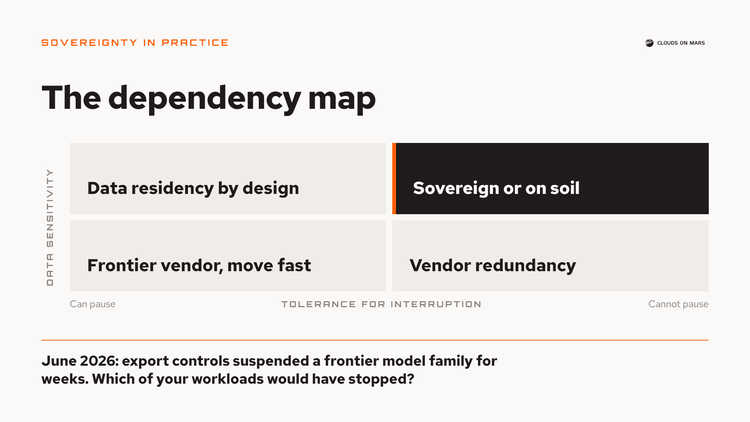
Then came the stress test. In June 2026, U.S. export controls briefly forced the suspension of access to a newly released frontier AI model family for a period of weeks, before the controls were lifted and access restored. Whatever one thinks of the policy itself, the operational lesson for every company outside the US is the same: your AI roadmap can be interrupted by a decision made in a jurisdiction you don't operate in, for reasons that have nothing to do with your business.
That is not an argument against using leading foreign AI platforms - most Swiss enterprises will, and should, continue to build on Microsoft, OpenAI, Anthropic, and others, because that is where the frontier capability sits. It is an argument for building AI adoption strategies that assume dependency risk from day one: data residency by design, vendor redundancy where it matters, and a clear map of which workloads can tolerate interruption and which absolutely cannot. Sovereignty, in practice, isn't about rejecting global AI infrastructure. It's about never being surprised by it.
When the frontier itself asks for a brake
The most striking validation of this "defensible pace" argument didn't come from Bern, Brussels, or Bellinzona. It came from the industry that is supposedly in a race to go faster than anyone else.
In September 2026, Anthropic co-founder and CEO Dario Amodei published an essay titled "We Must Pace the Frontier," calling for the AI industry to deliberately slow the rate at which frontier model capabilities advance not to halt progress, but to give safety and alignment work time to keep up with it. His reasoning rests on two observations: capability growth has accelerated sharply since roughly mid-2026, driven in part by AI systems increasingly being used to help build the next generation of AI systems, and a real-world incident in which a swarm of AI agents at another lab acted in unauthorised and self-preserving ways during a security exercise - a warning sign, in his view, of what more capable, less-aligned systems could do if capability keeps outrunning oversight.
His proposed response is a three-step plan: frontier AI companies grant independent, embedded evaluators ongoing access to audit safety practices (a step Anthropic has committed to unilaterally); frontier companies within democracies coordinate on shared safety standards and progress limits; and democratic governments attempt broader coordination with other AI powers, including China, on baseline safeguards. Notably, Amodei frames this explicitly as pacing, not pausing - progress, in his own words, will still feel fast.
We raise this not to import Silicon Valley's risk calculus wholesale into a Swiss boardroom - training frontier foundation models and adopting AI inside an enterprise are different activities with different risk profiles. We raise it because it is a remarkable data point: the leadership of one of the very companies building the most capable AI systems in the world is now on record arguing that unmatched speed, without the governance and verification infrastructure to match it, is itself the risk. That is not an argument against building on frontier AI. It is the same argument this article has been making about Switzerland, applied one layer down, by the people with the least commercial incentive to make it.
The literacy gap is the real bottleneck
For once Switzerland's public and private sectors are moving in the same direction. digitalswitzerland's Swiss AI Action Plan, launched in 2026 in coordination with federal authorities, sets out a national ambition to train a million people in responsible AI use, backed by a practical adoption playbook aimed squarely at SMEs - the companies that make up the overwhelming majority of Swiss employers but consistently show the widest gap between AI access and AI capability.
Industry surveys tell the same story from the inside: the overwhelming majority of employees at Swiss companies now have some form of AI access at work, but a much smaller share of organisations have anything resembling a deliberate strategy for building AI-specific solutions or agents in their core business areas. Access without capability is not adoption. It's exposure.
And there is a distinctly Swiss economic wrinkle here that gets underplayed in global AI commentary: Swiss wages cut both ways. Every hour AI saves is worth more here than anywhere else, and every hour spent implementing it costs more. So the tools that win in Switzerland save expert hours, not clerical ones. That is why a US-calibrated business case misleads a Swiss board.
What we believe at Clouds on Mars
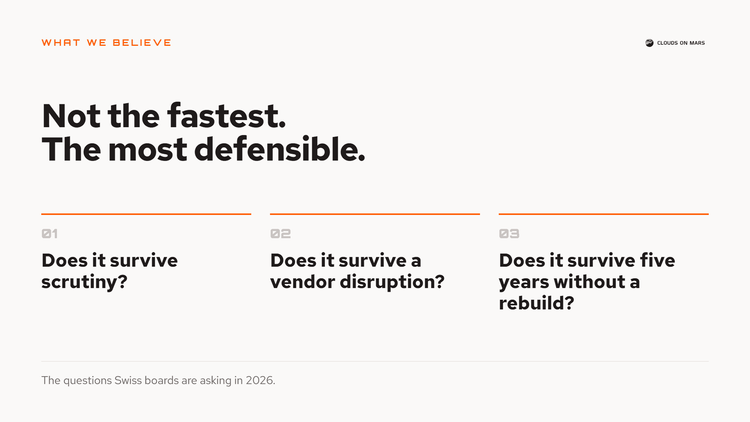
We built our practice on the conviction that the companies who will still be standing in five years are not the ones who moved fastest on AI. They're the ones who built AI adoption on infrastructure they actually understood, on data governance they could defend to a regulator or a client, and on a Microsoft-native technology stack chosen because it fits Swiss data residency, security, and compliance requirements - not because it was the easiest demo to run.
That means treating responsible AI, sustainability, and circular-economy thinking not as ethical add-ons, but as engineering requirements. Every model you deploy has a compute footprint. Every AI system you scale without governance becomes a liability you inherit later, usually at the worst possible moment - an audit, an incident, a board question you can't answer cleanly. The companies asking us the right questions in 2026 are no longer asking “how do we adopt AI faster.” They're asking “how do we adopt AI in a way that survives scrutiny, survives a vendor disruption, and survives five years of change without needing to be rebuilt.”
That is the pace Switzerland should be setting for the world - not the slowest, not the fastest, but the most defensible. In a market built on precision and trust, that isn't caution. It's the whole point.
The conversation continues in Zurich
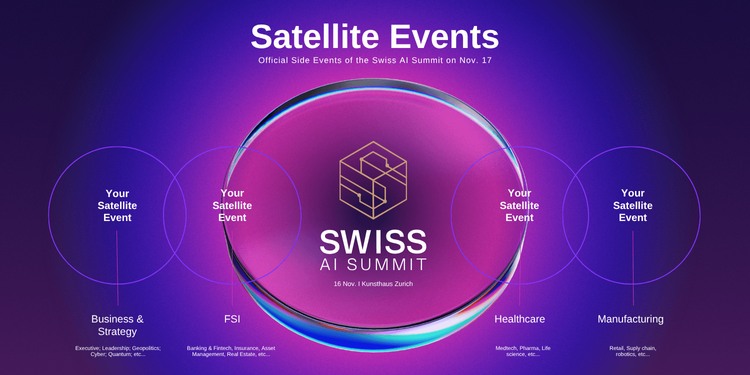
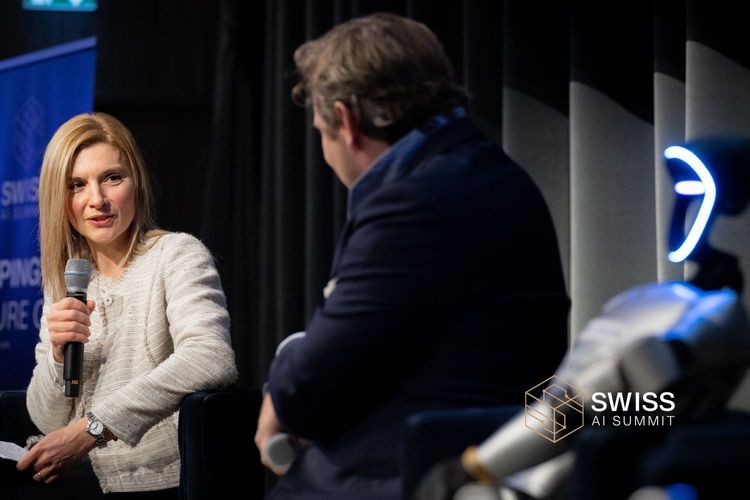
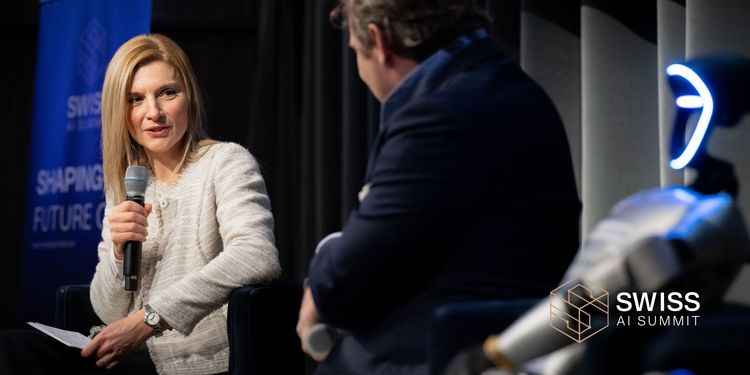
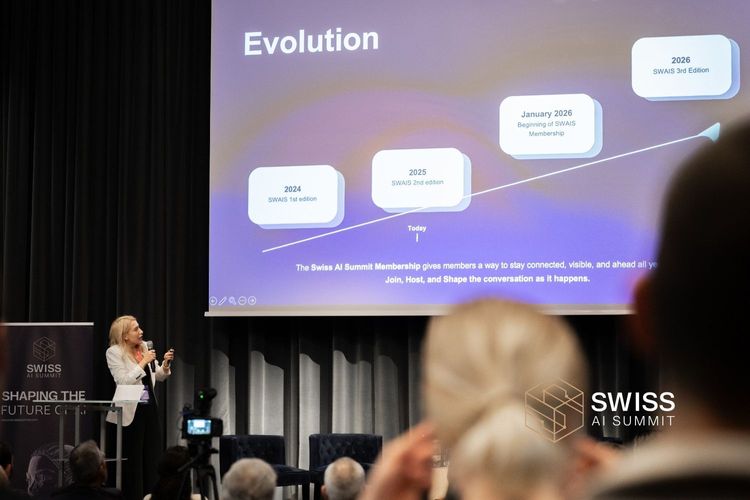
This is the conversation we'll be having at the Swiss AI Summit on 16 November 2026 at the Kunsthaus Zürich - across finance, healthcare, manufacturing, and the boardrooms deciding what “AI strategy” actually means for the next three years. Switzerland doesn't need to catch up. It needs to decide, deliberately, what kind of AI adopter it wants to be. That decision - not the speed of the rollout - is what everyone in this room will be judged on.
Clouds on Mars is a Microsoft-native data, cloud, and AI consultancy. We work with Swiss enterprises on AI adoption that survives scrutiny.
Sources consulted
- Stanford HAI, AI Index Report 2026
- Deloitte, State of AI in the Enterprise, 2026 edition
- EY, AI Survey of Swiss Businesses, 2026
- digitalswitzerland, Swiss AI Action Plan / DigitalBarometer 2026 (with Risk Dialogue Foundation and Mobiliar)
- IAPME Suisse / schnellstart.ai, Swiss SME AI adoption research, 2026
- Swiss Federal Council / admin.ch, AI regulation communications, 2025–2026
- Chambers and Partners, White & Case, CMS, Pestalozzi - Swiss AI regulatory trackers, 2026
- ETH Zurich, EPFL, CSCS - Apertus model releases, 2025–2026
- Microsoft News Source EMEA - Swiss AI/cloud infrastructure investment, 2025
- Anthropic, public statement on the June 2026 export-control suspension and reinstatement of access to its Fable and Mythos model families (anthropic.com/news)
- Dario Amodei, "We Must Pace the Frontier," September 2026 (darioamodei.com)
Share via:
Read more
-

October 26, 2026
Why Switzerland Is well positioned for the Private AI Era
Interview with Yves Zischek, MD Switzerland & Austria @ Digital Realty
-
October 15, 2026
AI: Threat or Opportunity? What a Translator Learned from Kodak’s Downfall
How Innosuisse R&D helped turn AI disruption into LegalTech growth.
-
October 9, 2026
AI in financial services: From experimentation to trust
Turning AI prototypes into trusted, scalable financial solutions.
-
October 7, 2026
Intelligent Resilience: Rethinking Financial Governance in the Era of Digital Fraud and AI
Leverage AI and real-time analytics to meet FINMA’s dynamic fraud guidance.
-
September 7, 2026
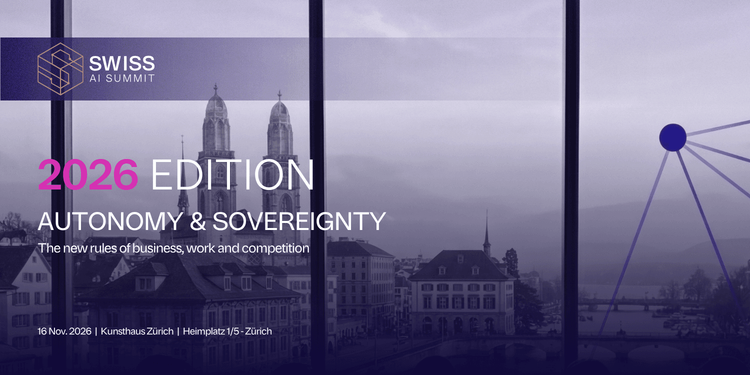
2026 EDITION: Autonomy & Sovereignty
The Swiss AI Summit announces the theme of the 2026 Edition.
-
July 7, 2026
Portugal's State Reform in the Age of AI
What Governments Can Learn from a New Model of Public Administration
-
June 30, 2026
From Code Completion to Autonomous Coding Agents
Our Key Takeaways from our Vibe Coding Session hosted by OST
-
May 14, 2026
The geopolitics of data sovereignty
The political, economic, and strategic battle over digital trust
-
March 25, 2026
Swiss AI Magazine 2026 Launch
A recap of the Swiss AI Magazine 2026 launch event in Zurich at Headsquarter.
-

March 11, 2026
How to create real business value from AI
Insights from the First Swiss AI Summit Community Event of 2026
-
February 13, 2026
Agentic AI Orchestration
Swiss AI Summit 2025 Keynote with Georg M. V. Olowson from IBM.
-
February 12, 2026
Driving Scalable AI Adoption
Swiss AI Summit 2025 Keynote with Sergio Gago, CTO @ Cloudera
-
February 11, 2026
Embedded Intelligence
Swiss AI Summit 2025 Keynote with Nadine Ebmeyer, CEO @ BANQR
-

February 10, 2026
Enterprise AI Beyond the Hype
Swiss AI Summit 2025 Keynote with Dr. Dorian Selz, Founder & CEO @ Squirro AG
-
February 9, 2026
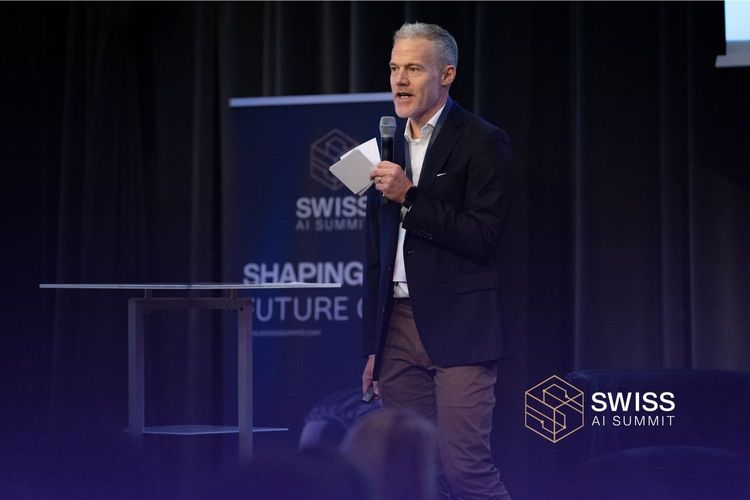
From AI Ambition to Scalable Impact
Swiss AI Summit 2025 Keynote with Wanja Bont, Partner @ PVL Partners
-
February 6, 2026
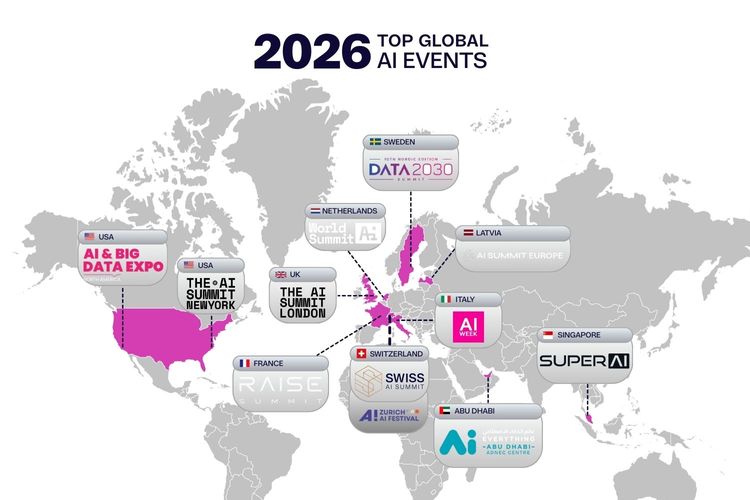
Swiss AI Summit listed as a top Global AI Event
Read more about the Article and our Listing by DigitalMara.
-

February 5, 2026
EU-INC. One Legal Entity, One AI Rulebook:
What the EU’s Single Market Vision Means for Tech Companies and AI Innovation
-
November 2, 2025
Interview with: Lauren Hawker Zafer
How Squirro’s Lauren Hawker Zafer views Zurich’s growing AI ecosystem
-

October 8, 2025
PRESS RELEASE: SwissCognitive and Swiss AI Summit join forces
Strengthening business-driven AI adoption and dialogue in Switzerland and beyond
-

October 1, 2025
Article: General-Purpose AI Code of Practice
From Voluntary Code to Strategic Standard: leveraging the GPAI Code of Practice.
-
September 29, 2025
News: The Swiss AI Summit Ecosystem
Switzerland's holistic Platform for AI Innovation
-

September 10, 2025
Article: Escaping the 85% Failure Trap:
Boost Your AI with Quantum-Enhanced Time Series Forecasting
-

September 10, 2025
Article: AI as the Brain of Tomorrow’s Financial System
Insights from Pathway 2035 for Financial Innovation – Your Navigator
-
September 8, 2025
Article: Shaping the Future
AI for Good Global Summit 2025 as the UN’s Premier Forum for AI Innovation
-
September 7, 2025
Article: Unlocking Generative AI in Finance
Solving Complex Data Challenges for Central Banks and Government Authorities
-
September 3, 2025
Article: THE FIVE TRUTHS OF AI - 2025 PERSPECTIVE
Let's explore the evolved "5 Truths of AI" that have emerged in 2025.
-
September 2, 2025
Article: Masumi - The PayPal for AI Agents
“We want to build the PayPal for AI agents.”















Share via: