

Authors

Timea Nagy
Founder & Lawyer , Swiss AI Summit

Jan Mikolon
Chief Technology Officer , Quantum Basel

Arlind Spahija
Head AI , Migros Bank

Timea Nagy
Founder & Lawyer , Swiss AI Summit
Published on:
March 11, 2026
Reading time:
10 minutes
How to create real business value from AI
Insights from the Roundtable
25 Feb 2026
The Swiss AI Summit Community (SWAIS Community) kicked off the year by tackling the question: “How to create Real Business Value from AI”? The roundtable discussion featured Jan Mikolon, CTO of QuantumBasel, and Arlind Spahija, Head AI of Migros Bank.
The roundtable brought together board members, executives, and senior practitioners to discuss why artificial intelligence initiatives so often fail to scale and what leaders can do to turn experimentation into sustained business value. While enthusiasm for generative and agentic AI is high, participants agreed that governance, data readiness, and human factors remain decisive constraints.
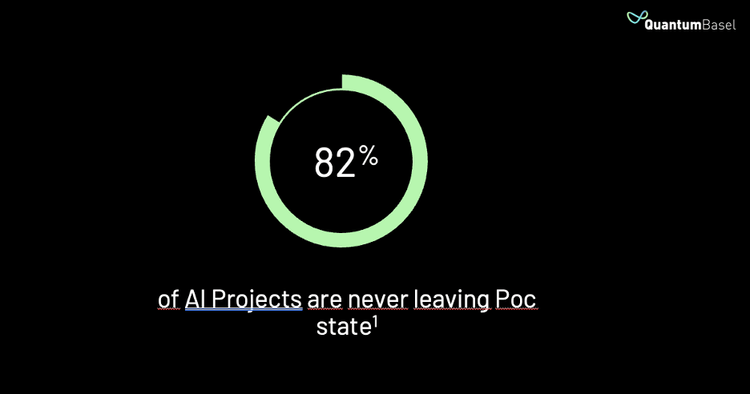
Why 82% AI Pilots Fail to Scale
Participants repeatedly referenced the widely observed phenomenon that the majority of proofs of concept never reach production. The reasons are rarely technical alone.
What are the reasons for the high failure rate?
- unrealistic expectations about what AI can deliver,
- insufficient attention to data quality, and the
- tendency to treat AI initiatives as isolated experiments rather than as part of a broader transformation agenda.
A recurring theme was that AI is frequently layered onto inefficient or poorly designed processes. In such cases, AI merely accelerates existing inefficiencies instead of creating value. Without clear ownership and accountability across end-to-end processes, even technically successful pilots struggle to survive organizational reality.
Measuring Business Value Beyond Experimentation
A central discussion point concerned the difficulty organizations face in measuring AI value. Many initiatives begin without a shared understanding of the intended business outcome. The roundtable converged on the view that value must be assessed through a combination of usecase impact, adoption rate, scalability, and total cost of ownership.
Time savings alone were seen as an incomplete metric. Participants emphasised timetomarket, quality improvements, and the ability for employees to focus on highervalue work as more meaningful indicators. Comparing AIsupported performance with humanonly baselines was highlighted as a practical way to demonstrate incremental value.
Data as the Hidden Bottleneck
While AI is often discussed in terms of models and tools, the discussion made clear that data engineering and data quality dominate realworld effort. In several industries, the majority of project time is spent preparing, cleaning, and integrating data before AI can be applied at all. Poor data quality not only delays projects but also undermines trust in outcomes.
This reality differentiates AI initiatives from many traditional IT projects.
Leaders must recognize that data readiness is a strategic investment rather than a technical afterthought.
Human and Organizational Factors
Beyond technology and data, human factors were identified as equally critical. Fear of job displacement, lack of AI literacy, and misaligned incentives can all hinder adoption.
Participants stressed the importance of involving end users early, framing AI as a productivity multiplier rather than a costcutting tool, and investing in education at board, executive, and employee levels.
A culture that allows learning from failure, rather than penalising it, was seen as essential. Without psychological safety and clear communication, even welldesigned solutions face resistance.
From Everyday AI to Customized AI
The discussion distinguished between three broad categories of AI adoption. First, everyday AI tools that improve individual productivity through standard, offtheshelf solutions. Second, domainspecific AI tailored to particular functions such as legal, research, or industrial applications. Third, fully customised AI built on proprietary data and integrated into core processes.
Participants agreed that while everyday AI delivers quick wins, sustainable competitive advantage increasingly depends on customised AI aligned with strategic priorities and governed at the highest levels.
Implications for Boards and Executives
The roundtable concluded that AI is no longer an IT topic but a leadership responsibility. Boards and executive teams must be sufficiently literate to challenge assumptions, prioritise the right use cases, and oversee risks and investments. Moving from pilots to production requires clarity of purpose, disciplined governance, and sustained commitment across the organisation.
AI, when treated as an organisational transformation rather than a standalone technology project, can deliver measurable business value and strategic resilience.
Key takeaways
• AI must be tied to business outcomes. Successful initiatives start with clear business problems and measurable impact rather than technology experimentation.
• Most AI projects fail to reach production. Up to 85% of AI initiatives stall at the pilot stage, often due to poor alignment with business needs, unrealistic scope, or weak execution.
• Focus on practical use cases that deliver measurable value. Real-world implementations—such as internal assistants, email automation, and knowledge retrieval systems—can significantly improve efficiency when integrated into daily workflows.
• Strategic alignment between business and technology is critical. AI initiatives succeed when leadership, business teams, and technical teams collaborate closely from the beginning.
• Learn from proven implementations. Case studies from organizations like Migros Bank highlight the importance of clear priorities, iterative deployment, and transparent evaluation of results.
• Not every problem requires AI. Validating feasibility and impact early helps organizations identify where AI truly creates value—and where it does not.
• Interactive validation accelerates adoption. Testing real use cases against organizational challenges helps leaders move from ideas to actionable next steps.
Share via:
Read more
-

September 7, 2026
2026 EDITION: Autonomy & Sovereignty
The Swiss AI Summit announces the theme of the 2026 Edition.
-

July 7, 2026
Portugal's State Reform in the Age of AI
What Governments Can Learn from a New Model of Public Administration
-

June 30, 2026
From Code Completion to Autonomous Coding Agents
Our Key Takeaways from our Vibe Coding Session hosted by OST
-
May 14, 2026
The geopolitics of data sovereignty
The political, economic, and strategic battle over digital trust
-

March 25, 2026
Swiss AI Magazine 2026 Launch
A recap of the Swiss AI Magazine 2026 launch event in Zurich at Headsquarter.
-

February 13, 2026
Agentic AI Orchestration
Swiss AI Summit 2025 Keynote with Georg M. V. Olowson from IBM.
-

February 12, 2026
Driving Scalable AI Adoption
Swiss AI Summit 2025 Keynote with Sergio Gago, CTO @ Cloudera
-
February 11, 2026
Embedded Intelligence
Swiss AI Summit 2025 Keynote with Nadine Ebmeyer, CEO @ BANQR
-

February 10, 2026
Enterprise AI Beyond the Hype
Swiss AI Summit 2025 Keynote with Dr. Dorian Selz, Founder & CEO @ Squirro AG
-

February 9, 2026
From AI Ambition to Scalable Impact
Swiss AI Summit 2025 Keynote with Wanja Bont, Partner @ PVL Partners
-
February 6, 2026
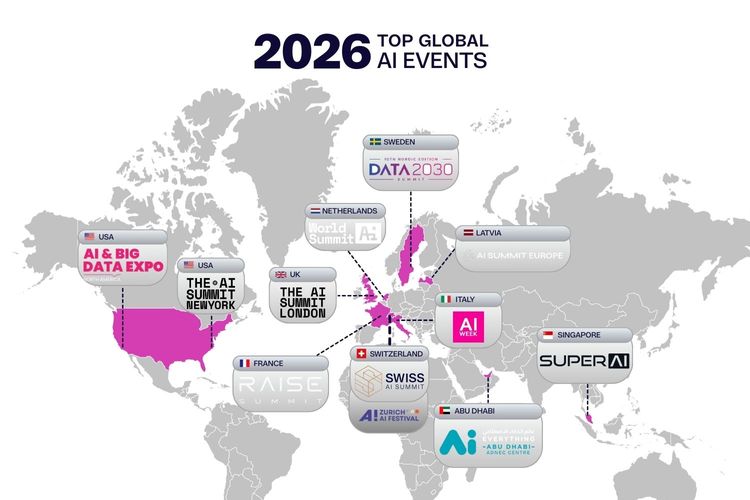
Swiss AI Summit listed as a top Global AI Event
Read more about the Article and our Listing by DigitalMara.
-

February 5, 2026
EU-INC. One Legal Entity, One AI Rulebook:
What the EU’s Single Market Vision Means for Tech Companies and AI Innovation
-

November 2, 2025
Interview with: Lauren Hawker Zafer
How Squirro’s Lauren Hawker Zafer views Zurich’s growing AI ecosystem
-

October 8, 2025
PRESS RELEASE: SwissCognitive and Swiss AI Summit join forces
Strengthening business-driven AI adoption and dialogue in Switzerland and beyond
-

October 1, 2025
Article: General-Purpose AI Code of Practice
From Voluntary Code to Strategic Standard: leveraging the GPAI Code of Practice.
-
September 29, 2025
News: The Swiss AI Summit Ecosystem
Switzerland's holistic Platform for AI Innovation
-

September 10, 2025
Article: Escaping the 85% Failure Trap:
Boost Your AI with Quantum-Enhanced Time Series Forecasting
-

September 10, 2025
Article: AI as the Brain of Tomorrow’s Financial System
Insights from Pathway 2035 for Financial Innovation – Your Navigator
-

September 8, 2025
Article: Shaping the Future
AI for Good Global Summit 2025 as the UN’s Premier Forum for AI Innovation
-

September 7, 2025
Article: Unlocking Generative AI in Finance
Solving Complex Data Challenges for Central Banks and Government Authorities
-

September 3, 2025
Article: THE FIVE TRUTHS OF AI - 2025 PERSPECTIVE
Let's explore the evolved "5 Truths of AI" that have emerged in 2025.
-

September 2, 2025
Article: Masumi - The PayPal for AI Agents
“We want to build the PayPal for AI agents.”






































Share via: