

The geopolitics of data sovereignty
Executive Summary
Data sovereignty is rapidly becoming one of the defining strategic issues of the digital economy. Governments, cloud providers, AI companies, and enterprises increasingly use the term as a symbol of trust, resilience, and control. Yet despite its growing importance, there is still no universally accepted legal definition or operational standard for what sovereignty actually means in practice.
This article argues that data sovereignty should not be understood as isolation or political control over innovation, but rather as a governance capability: the ability of organizations and states to manage dependencies, legal exposure, operational resilience, and digital trust within globally interconnected technology ecosystems.
No longer just a technical debate.
There is a growing tendency to speak about data sovereignty as if it were a purely technical or purely legal problem. It is neither. Data sovereignty has become one of the defining political and economic tensions of the digital era precisely because it sits between infrastructure, law, national security, markets, and power.
Yet the public conversation around sovereignty is increasingly collapsing into simplistic binaries:
• Europe vs. the United States.
• Public cloud vs. sovereign cloud.
• Foreign vs. domestic.
• Secure vs. insecure.
Reality is considerably more uncomfortable. What is currently unfolding is not simply a debate about where data is stored. It is a struggle over who controls the digital foundations of modern society, and who gets to define legitimacy in the process.
The rise of sovereignty as a trust narrative.
After GDPR entered into force, “GDPR compliant” became a powerful market differentiator. Organizations that previously viewed data protection as a legal burden quickly recognized its commercial value. Customers, investors, and enterprise buyers began associating compliance with trustworthiness. The same dynamic emerged in sustainability. Long before ESG standards became fully harmonized, companies increasingly marketed themselves as environmentally responsible because the market demanded it. A similar transition is now happening with sovereignty. Organizations increasingly position themselves as:
- sovereign AI providers,
- sovereign cloud vendors,
- sovereign infrastructure operators,
- or sovereign technology ecosystems.
The problem is that sovereignty currently lacks the measurable standardization associated with traditional compliance frameworks. There is:
- no globally accepted sovereignty certification,
- no universal legal benchmark,
- no single operational framework,
- and no agreed definition of what being “sovereign” actually requires.
This creates significant room for ambiguity and gives birth to multiple misconceptions. Sovereignty risks becoming both a legitimate governance concern and a loosely defined marketing narrative at the same time.
1. The misconception that sovereignty depends entirely on government approval.
Governments undeniably play a legitimate role in protecting critical infrastructure, cybersecurity, national resilience, and public trust. Concerns surrounding foreign access laws, cyber threats, AI governance, and strategic dependencies are real and increasingly important.
However, the solution cannot become a system where technological legitimacy depends entirely on governmental approval structures. If sovereignty evolves into a framework where innovation requires political authorization before infrastructure choices can be made, Europe risks undermining its own competitiveness.
Replacing dependency on hyperscalers with dependency on state-controlled approval mechanisms would not create resilience. It would simply centralize power differently.
Sovereignty, therefore, cannot be solved by governments alone. Nor can it be solved by industry alone.
2. The misconception that sovereignty means isolation.
One of the biggest misunderstandings in the sovereignty discussion is the assumption that sovereignty means isolation. It does not. In reality, complete independence in modern technology ecosystems is nearly impossible.
A recent Swiss legal briefing on cloud usage and digital sovereignty stated clearly:
“Digital sovereignty means neither self-sufficiency nor isolation, but rather the ability to manage and control the use of external digital services independently.”
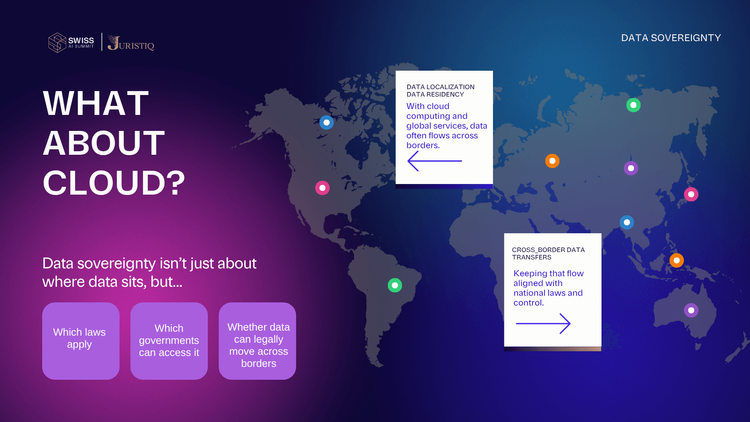
Digital infrastructure is inherently interconnected. Even organizations that market “sovereign” infrastructure still rely on global semiconductor supply chains, open-source libraries, international networks, foreign hardware, or multinational cloud ecosystems somewhere in the stack. The real issue is therefore not dependency itself, but unmanaged dependency. This distinction becomes particularly important when discussing cloud infrastructure and cross-border data governance.
3. Data sovereignty is not a single legal concept
Another misconception is that data sovereignty is a clearly defined legal doctrine. It is not.
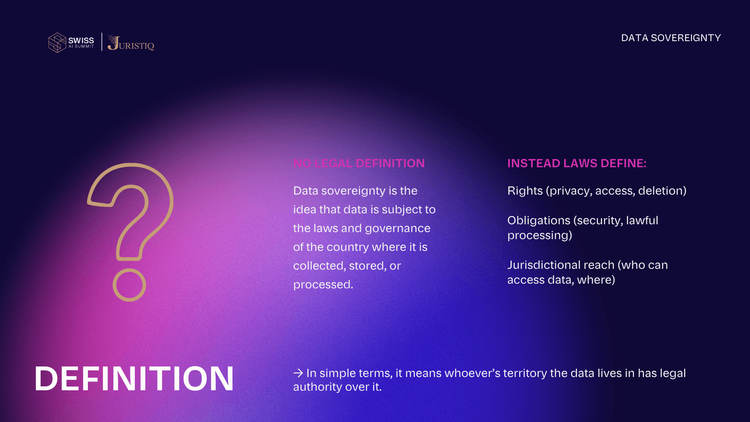
There is no universally accepted legal definition of data sovereignty in international law. Instead, the concept has emerged from overlapping regulatory systems, privacy laws, cybersecurity frameworks, cloud governance models, and geopolitical concerns.
The OECD described data sovereignty as “the idea that data is subject to the laws and governance structures of the country where it is collected.” Meanwhile, the European Union operationalizes sovereignty through mechanisms such as the General Data Protection Regulation, transfer restrictions, adequacy decisions, and governance frameworks around cloud and AI infrastructure.
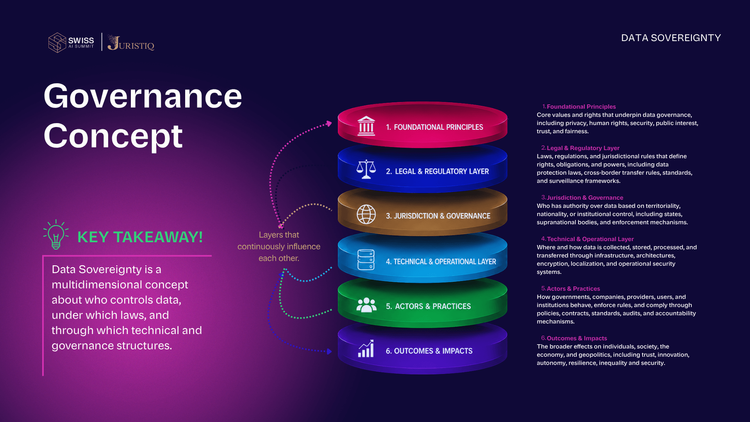
In practice, sovereignty has become a layered concept involving:
• jurisdiction,
• access rights,
• infrastructure control,
• operational dependence,
• governance,
• and strategic autonomy.
The result is that companies are increasingly navigating multiple, sometimes conflicting, legal realities simultaneously.
Sovereignty is a governance capability, not a marketing label.
One of the greatest risks in the current sovereignty debate is that the concept becomes reduced to a branding exercise rather than treated as a meaningful governance framework. Terms such as “sovereign cloud,” “sovereign AI,” or “sovereign infrastructure” are increasingly used in marketing and political narratives, often creating the impression of complete independence, absolute legal protection, or total control over digital systems. In reality, such guarantees rarely exist in modern interconnected technology ecosystems.
True sovereignty does not mean eliminating all dependencies or operating in complete isolation. Instead, sovereignty is the ability of organizations, governments, and institutions to understand their dependencies, manage legal and operational risks, preserve strategic flexibility, and maintain trust within increasingly complex digital environments. It is therefore less about achieving absolute control and more about building resilient governance structures that allow organizations to make informed and conscious decisions about infrastructure, data flows, and technological partnerships.
This distinction is particularly important because modern digital systems are deeply interconnected across jurisdictions, providers, and supply chains. Even organizations that position themselves as “sovereign” continue to rely on global cloud ecosystems, open-source technologies, international connectivity, and foreign hardware components. Sovereignty should therefore not be understood as a binary condition where an organization is either sovereign or non-sovereign. Rather, it exists on a spectrum shaped by governance maturity, operational transparency, legal awareness, and the ability to manage strategic dependencies responsibly.
For businesses, sovereignty can no longer be treated purely as a compliance exercise or marketing claim. It is becoming a core governance issue that directly affects resilience, procurement decisions, regulatory exposure, enterprise trust, and long-term competitiveness.
Organizations that approach sovereignty seriously will not simply ask where their data is stored. They will also examine:
- who controls the infrastructure,
- which legal systems apply,
- what geopolitical dependencies exist,
- and how resilient their operational models remain in an increasingly fragmented digital environment.
Conclusion
The future of data sovereignty will not be determined by who claims independence the loudest, but by who builds the most trustworthy, transparent, and resilient governance ecosystems.
The central challenge is no longer whether organizations can eliminate dependency entirely. In globally interconnected digital systems, that is unrealistic. The real challenge is whether governments, enterprises, and infrastructure providers can manage dependencies consciously, transparently, and responsibly while preserving innovation, competitiveness, and democratic trust.
This is why sovereignty is becoming far more than a technical architecture debate. It is evolving into a strategic measure of political credibility, economic resilience, and institutional trust in the digital age.
Share via:
Read more
-
September 7, 2026
2026 EDITION: Autonomy & Sovereignty
The Swiss AI Summit announces the theme of the 2026 Edition.
-
July 7, 2026
Portugal's State Reform in the Age of AI
What Governments Can Learn from a New Model of Public Administration
-
June 30, 2026
From Code Completion to Autonomous Coding Agents
Our Key Takeaways from our Vibe Coding Session hosted by OST
-

March 25, 2026
Swiss AI Magazine 2026 Launch
A recap of the Swiss AI Magazine 2026 launch event in Zurich at Headsquarter.
-

March 11, 2026
How to create real business value from AI
Insights from the First Swiss AI Summit Community Event of 2026
-

February 13, 2026
Agentic AI Orchestration
Swiss AI Summit 2025 Keynote with Georg M. V. Olowson from IBM.
-

February 12, 2026
Driving Scalable AI Adoption
Swiss AI Summit 2025 Keynote with Sergio Gago, CTO @ Cloudera
-
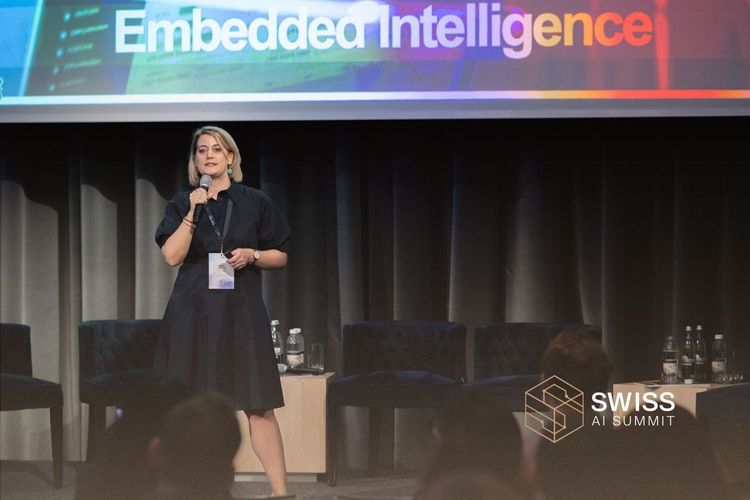
February 11, 2026
Embedded Intelligence
Swiss AI Summit 2025 Keynote with Nadine Ebmeyer, CEO @ BANQR
-

February 10, 2026
Enterprise AI Beyond the Hype
Swiss AI Summit 2025 Keynote with Dr. Dorian Selz, Founder & CEO @ Squirro AG
-

February 9, 2026
From AI Ambition to Scalable Impact
Swiss AI Summit 2025 Keynote with Wanja Bont, Partner @ PVL Partners
-

February 6, 2026
Swiss AI Summit listed as a top Global AI Event
Read more about the Article and our Listing by DigitalMara.
-
February 5, 2026
EU-INC. One Legal Entity, One AI Rulebook:
What the EU’s Single Market Vision Means for Tech Companies and AI Innovation
-
November 2, 2025
Interview with: Lauren Hawker Zafer
How Squirro’s Lauren Hawker Zafer views Zurich’s growing AI ecosystem
-
October 8, 2025
PRESS RELEASE: SwissCognitive and Swiss AI Summit join forces
Strengthening business-driven AI adoption and dialogue in Switzerland and beyond
-

October 1, 2025
Article: General-Purpose AI Code of Practice
From Voluntary Code to Strategic Standard: leveraging the GPAI Code of Practice.
-
September 29, 2025
News: The Swiss AI Summit Ecosystem
Switzerland's holistic Platform for AI Innovation
-

September 10, 2025
Article: Escaping the 85% Failure Trap:
Boost Your AI with Quantum-Enhanced Time Series Forecasting
-

September 10, 2025
Article: AI as the Brain of Tomorrow’s Financial System
Insights from Pathway 2035 for Financial Innovation – Your Navigator
-

September 8, 2025
Article: Shaping the Future
AI for Good Global Summit 2025 as the UN’s Premier Forum for AI Innovation
-
September 7, 2025
Article: Unlocking Generative AI in Finance
Solving Complex Data Challenges for Central Banks and Government Authorities
-

September 3, 2025
Article: THE FIVE TRUTHS OF AI - 2025 PERSPECTIVE
Let's explore the evolved "5 Truths of AI" that have emerged in 2025.
-

September 2, 2025
Article: Masumi - The PayPal for AI Agents
“We want to build the PayPal for AI agents.”





























Share via: