
Author

Swiss AI Summit
Published on:
October 7, 2026
Intelligent Resilience: Rethinking Financial Governance in the Era of Digital Fraud and AI
Intelligent Resilience: Rethinking Financial Governance in the Era of Digital Fraud and AI
The rapid evolution of digital finance has created a fundamental paradox for banking executives and compliance leaders. On one hand, financial crime has grown increasingly sophisticated, leveraging automation, deepfakes, synthetic identities, and rapid movement laundering schemes that challenge established defensive frameworks. On the other hand, financial institutions face a daunting regulatory landscape, where every emerging threat is often met with calls for additional compliance layers, manual checklists, and operational friction.
Meanwhile, regulatory expectations are shifting. FINMA’s recent guidance on digital fraud risks, directed at banks and Fintech license holders under Article 1b of the Banking Act, signifies a pivotal change in supervisory perspective. FINMA’s recent guidance places considerably stronger emphasis on effective, timely, and increasingly sophisticated fraud detection and transaction monitoring. This makes AI and other advanced analytics increasingly relevant in practice, without making them a regulatory requirement as such.
Digital fraud and financial crime are no longer merely technical or operational concerns; they are core governance and strategic risk management challenges. To combat scalable digital threats, the future of compliance cannot rely solely on static rules or excessive administrative procedures. Instead, institutions should move toward adaptive operational resilience, where advanced analytics and responsible artificial intelligence become practical assets to satisfy these heightened expectations within the modern control framework.
Beyond Risk: AI as a Pillar of Compliance
For years, boardrooms have treated artificial intelligence primarily as a category of risk. Discussions have naturally focused on model opacity, algorithmic bias, data privacy, outsourcing dependencies, and operational vulnerability. While these concerns remain valid, viewing AI solely through a risk mitigation lens creates a critical blind spot.
Modern fraud is inherently digital, automated, and scalable. Fraudsters do not operate within predictable, static boundaries; they deploy sophisticated social engineering, deepfake media, altered documentation, and multi-layered transactional paths designed to bypass rigid rules. Relying exclusively on manual checks or fixed statistical thresholds ensures that an institution remains perpetually reactive. Static thresholds are blunt instruments: once fraudsters identify where a limit lies, they adapt their behavior to operate just beneath it.
To keep pace, controls must become as dynamic as the threats they target. While regulators expect robust risk detection rather than specific technological adoption, sophisticated tools become essential in practice. Advanced analytical systems allow institutions to analyze complex behavioral patterns, evaluate cross-channel correlation signals, and detect anomalies in real time across onboarding, e-banking, and payments. Far from acting as a compliance shortcut, advanced analytics and AI are fast becoming practical prerequisites for operational effectiveness. Furthermore, in high-volume environments such as Anti-Money Laundering (AML) monitoring and sanctions screening, advanced pattern recognition can materially reduce false positive alerts when appropriately designed and validated, allowing specialized compliance teams to focus their resources on genuine, high-risk threats.
Principles Over Paperwork: The Case for Sector-Specific Governance supplemented by horizontal rules
When addressing emerging technological risks, the impulse of many regulatory regimes is to introduce broad, overarching legislation. However, imposing rigid regulatory layers often incentivizes formalistic, box-ticking compliance rather than meaningful risk reduction.
The Swiss approach to AI regulation is primarily sector-specific, supplemented by targeted horizontal rules in selected areas. This strategy offers a compelling alternative to sweeping, uniform horizontal frameworks like the EU AI Act. Artificial intelligence is not a single product or a uniform risk category; a generative text summarizer presents vastly different operational and ethical considerations than an automated credit-scoring model or a real-time AML transaction engine. Regulating AI in the abstract risks stifling innovation without effectively addressing specific domain hazards.
Regulators should remain technology-neutral, setting clear expectations for effective risk management rather than prescribing specific technical tools. FINMA’s guidance reinforces this technology-neutral stance by focusing on outcome-oriented supervisory expectations, such as rapid incident response, systematic monitoring, and clear governance, rather than mandating specific IT solutions. Existing financial service frameworks, such as governance standards, internal audit protocols, risk management controls, data protection laws, and outsourcing guidelines, already provide a robust structure for governing new technologies. The goal of executive management should not be to create duplicate governance silos for AI, but to seamlessly integrate advanced analytical capabilities into these established operational frameworks.
Operationalizing AI Governance: A Nine-Pillar Framework
To establish a defensible, audit-ready AI governance posture without creating unnecessary administrative friction, senior management and board members should align their operations across nine pragmatic pillars:
- Inventory & Visibility: Establish a comprehensive register of all AI implementations across the enterprise, covering internally developed tools as well as third-party solutions.
- Third-Party & Vendor Risk Management: Implement rigorous due diligence, ongoing oversight, and clear contractual standards for external vendor models, software-as-a-service (SaaS) features, and outsourced data pipelines.
- Risk Classification: Categorize use cases based on impact and exposure. An internal administrative writing tool requires a vastly different oversight model than a live transaction-blocking algorithm.
- Interdisciplinary Ownership: Assign explicit business and operational accountability. Governance cannot reside solely within IT; it requires continuous alignment across Legal, Compliance, Risk, and Line-of-Business leaders.
- Data Governance & Integrity: Enforce clear standards for data confidentiality, access permissions, purpose limitation, and privacy compliance across all training and operational data pipelines.
- Continuous Validation: Implement rigorous initial validation and ongoing monitoring protocols to test system performance, drift, and efficacy over time.
- Independent Review & Audit: Ensure regular, objective evaluations by independent internal audit functions or external third-party reviewers to validate model governance, control design, and operational compliance. Explicitly include third-party vendors and outsourced AI, identity-verification, fraud-detection and transaction-monitoring services in the risk and assurance framework. Verify that vendor controls perform effectively, emerging fraud patterns can be addressed promptly, and the institution retains adequate oversight, access to relevant evidence, and clear accountability for outcomes.
- Proportional Human Oversight: Design human-in-the-loop mechanisms that allow compliance personnel to meaningfully review, challenge, and override automated findings.
- Contextual Explainability: Document the design, testing parameters, operational limits, and incident response procedures of automated systems.
In practice, explainability must be tailored to the stakeholder. A data scientist requires deep architectural insights; a compliance officer needs to understand why a specific alert was generated; a client needs clear communication regarding a delayed transaction; and a regulator requires proof that the system is properly governed and tested. Token explainability or "AI washing" provides little value; true explainability exists to support human accountability and decision-making.
Ecosystem Responsibility and the Limits of Control
As real-time payment rails expand globally, institutions face an inherent tension between payment velocity and fraud prevention. While high-speed infrastructure is vital for modern commerce, it restricts the window available to intercept fraudulent transactions before execution.
Promising full control in a real-time environment creates a false sense of security. In alignment with regulatory calls for timely and proactive surveillance, financial institutions must build adaptive response mechanisms rather than relying on manual checks. These mechanisms evaluate risk markers pre-execution, such as new login devices, unusual beneficiary patterns, rapid movement of funds, or sudden behavioral shifts.
Crucially, digital fraud cannot be solved by financial institutions in isolation. Fraudsters exploit vulnerabilities across the broader digital infrastructure, leveraging telecom networks, social media platforms, e-commerce portals, and payment schemes. Effective defense requires an ecosystem-wide response, pairing robust institution-level security design with cross-industry collaboration.
At the same time, institutions must strike a balanced perspective on client responsibility. While banks must provide secure environments, clear warnings, and frictionless safe-action pathways, a mature digital society also relies on user vigilance. Systems should be designed so that secure actions are natural and intuitive, while high-risk behaviors trigger explicit, clear friction points for the user.
Executive Board Priorities: Moving From Bureaucracy to Resilience
For board members and C-suite executives, FINMA’s guidance and the evolution of AI-driven compliance serve as a call to action. Governance is no longer measured by the volume of policies produced, but by the measurable resilience of the institution's control framework and the speed with which suspicious activity is identified and addressed.
To evaluate whether an organization is adequately prepared, leadership should focus on four essential questions:
- Exposure Understanding: Do we have clear visibility of our fraud and financial crime exposures across all digital customer touchpoints, including onboarding, e-banking, and payment rails?
- Clear Ownership: Is there defined executive ownership for digital fraud and AI governance, or does the topic fall between the cracks of IT, Risk, and Compliance?
- Response Velocity: Do we actively measure our detection and response metrics, and are our systems equipped to adapt dynamically to new fraud vectors?
- Targeted Innovation: Are we utilizing technology in a way that is legally compliant, operationally effective, and proportionate to our risk profile?
The choice facing financial institutions is not between manual compliance and unchecked algorithmic automation. The future lies in responsible, AI-supported governance. By satisfying regulatory mandates for effective monitoring through modern analytical capabilities, forward-thinking institutions can build an agile, resilient defense against the financial crimes of tomorrow.
Bibliography
FINMA Guidance 02/2026 on digital fraud risks: https://www.finma.ch/en/~/media/finma/dokumente/dokumentencenter/myfinma/4dokumentation/finma-aufsichtsmitteilungen/20260112-finma-aufsichtsmitteilung-02-2026.pdf
Cornelia Stengel Commentary from 21.04.2026: https://www.fuw.ch/finma-fordert-ai-gegen-betrug-paradigmenwechsel-beim-transaktionsmonitoring-434312275182
Share via:
Read more
-

October 26, 2026
Why Switzerland Is well positioned for the Private AI Era
Interview with Yves Zischek, MD Switzerland & Austria @ Digital Realty
-
October 15, 2026
AI: Threat or Opportunity? What a Translator Learned from Kodak’s Downfall
How Innosuisse R&D helped turn AI disruption into LegalTech growth.
-

October 13, 2026
The Myth of Fast: Why Switzerland's AI Advantage Depends on What It Refuses to Rush
Clouds on Mars’ perspective on AI adoption and what's at stake for Switzerland
-
October 9, 2026
AI in financial services: From experimentation to trust
Turning AI prototypes into trusted, scalable financial solutions.
-

September 7, 2026
2026 EDITION: Autonomy & Sovereignty
The Swiss AI Summit announces the theme of the 2026 Edition.
-

July 7, 2026
Portugal's State Reform in the Age of AI
What Governments Can Learn from a New Model of Public Administration
-

June 30, 2026
From Code Completion to Autonomous Coding Agents
Our Key Takeaways from our Vibe Coding Session hosted by OST
-
May 14, 2026
The geopolitics of data sovereignty
The political, economic, and strategic battle over digital trust
-

March 25, 2026
Swiss AI Magazine 2026 Launch
A recap of the Swiss AI Magazine 2026 launch event in Zurich at Headsquarter.
-

March 11, 2026
How to create real business value from AI
Insights from the First Swiss AI Summit Community Event of 2026
-

February 13, 2026
Agentic AI Orchestration
Swiss AI Summit 2025 Keynote with Georg M. V. Olowson from IBM.
-

February 12, 2026
Driving Scalable AI Adoption
Swiss AI Summit 2025 Keynote with Sergio Gago, CTO @ Cloudera
-

February 11, 2026
Embedded Intelligence
Swiss AI Summit 2025 Keynote with Nadine Ebmeyer, CEO @ BANQR
-

February 10, 2026
Enterprise AI Beyond the Hype
Swiss AI Summit 2025 Keynote with Dr. Dorian Selz, Founder & CEO @ Squirro AG
-

February 9, 2026
From AI Ambition to Scalable Impact
Swiss AI Summit 2025 Keynote with Wanja Bont, Partner @ PVL Partners
-

February 6, 2026
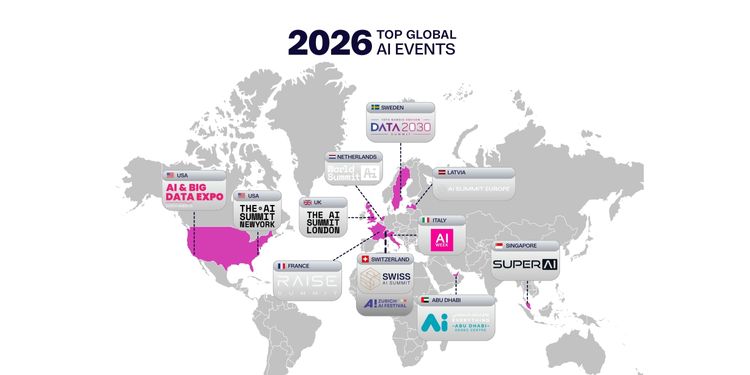
Swiss AI Summit listed as a top Global AI Event
Read more about the Article and our Listing by DigitalMara.
-

February 5, 2026
EU-INC. One Legal Entity, One AI Rulebook:
What the EU’s Single Market Vision Means for Tech Companies and AI Innovation
-

November 2, 2025
Interview with: Lauren Hawker Zafer
How Squirro’s Lauren Hawker Zafer views Zurich’s growing AI ecosystem
-

October 8, 2025
PRESS RELEASE: SwissCognitive and Swiss AI Summit join forces
Strengthening business-driven AI adoption and dialogue in Switzerland and beyond
-

October 1, 2025
Article: General-Purpose AI Code of Practice
From Voluntary Code to Strategic Standard: leveraging the GPAI Code of Practice.
-

September 29, 2025
News: The Swiss AI Summit Ecosystem
Switzerland's holistic Platform for AI Innovation
-

September 10, 2025
Article: Escaping the 85% Failure Trap:
Boost Your AI with Quantum-Enhanced Time Series Forecasting
-

September 10, 2025
Article: AI as the Brain of Tomorrow’s Financial System
Insights from Pathway 2035 for Financial Innovation – Your Navigator
-

September 8, 2025
Article: Shaping the Future
AI for Good Global Summit 2025 as the UN’s Premier Forum for AI Innovation
-

September 7, 2025
Article: Unlocking Generative AI in Finance
Solving Complex Data Challenges for Central Banks and Government Authorities
-

September 3, 2025
Article: THE FIVE TRUTHS OF AI - 2025 PERSPECTIVE
Let's explore the evolved "5 Truths of AI" that have emerged in 2025.
-

September 2, 2025
Article: Masumi - The PayPal for AI Agents
“We want to build the PayPal for AI agents.”














































Share via: