


Published on:
June 12, 2026
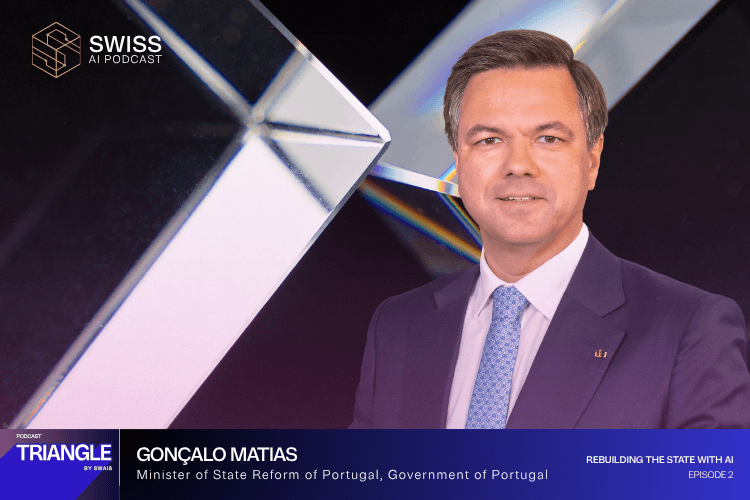
Gonçalo Matias | Portugal's State Reform in the Age of AI
Portugal's State Reform in the Age of AI: What Governments Can Learn from a New Model of Public Administration
The Real AI Challenge Is Not Technology. It's the government.
Around the world, governments are racing to adopt artificial intelligence. Most discussions focus on models, infrastructure, regulation, or investment. Yet one of the most important lessons emerging from Portugal suggests that AI alone is not the answer. The real challenge is the government itself.
Many public institutions continue to operate according to administrative structures designed decades ago, long before cloud computing, real-time data exchange, or artificial intelligence existed. As technology advances exponentially, government processes often remain trapped in linear systems built for another era.
Portugal is attempting something more ambitious than digitalization. It is attempting to redesign how the state functions. Under the leadership of Minister of State Reform Gonçalo Matias, the country has launched an agenda that combines simplification, digital transformation, interoperability, and AI deployment into a broader effort to modernize public administration.
The objective is straightforward but transformative: shift government from a bureaucracy-centered model to a citizen-centered service model. If successful, Portugal's experiment may offer one of Europe's most important case studies in AI-enabled state reform.
The Hidden Cost of Bureaucracy
Public debate often treats bureaucracy as an inconvenience. In reality, bureaucracy is an economic cost. Every delayed permit, duplicated document request, prolonged procurement procedure, or fragmented administrative process creates friction that slows economic activity, increases costs, and weakens public trust.
For decades, governments have attempted to solve these problems through incremental reforms. Yet many modernization efforts have focused primarily on digitizing existing processes rather than questioning whether those processes should exist in the first place. This distinction is crucial.
Portugal's reform strategy begins with simplification before digitalization. Instead of asking how technology can automate bureaucracy, the government is asking a more fundamental question: Why does the bureaucracy exist at all?
Only after procedures are redesigned does technology enter the equation. This approach mirrors successful private-sector transformations. Organizations rarely achieve meaningful productivity gains by automating inefficient workflows. The largest gains come from redesigning the workflow itself. Government is no different.
AI as an Engine of Administrative Productivity
One of the clearest examples can be found in construction licensing. Across Europe, housing shortages have become both an economic and political challenge. Yet in many jurisdictions, construction projects face years of administrative review before development can even begin. Portugal identified permitting as a systemic bottleneck.
Rather than simply digitizing paperwork, the government redesigned the licensing process itself. Agencies that previously reviewed documentation sequentially are being reorganized to operate simultaneously. Documentation management is increasingly automated. AI is being introduced to verify completeness, process submissions, and support administrative workflows. The expected outcome is striking. Processes that historically required five to six years could be reduced to three or four months. The implications extend far beyond administrative efficiency. Faster approvals reduce financing costs, unlock housing supply, accelerate investment, and improve affordability. In other words, administrative reform becomes economic policy. The same logic applies to public procurement.
Governments depend on procurement systems to build hospitals, schools, transportation infrastructure, and public services. Yet procurement processes often become trapped in documentation-heavy workflows that delay critical investments. AI-powered document analysis and workflow automation offer an opportunity to dramatically shorten decision cycles while maintaining oversight and accountability. The lesson is clear: AI creates value when applied to high-friction administrative systems that constrain economic activity.
Breaking Down the Silos of Government
Perhaps the most significant aspect of Portugal's reform agenda is interoperability. Modern governments collect enormous amounts of information. Yet that information is often trapped inside institutional silos.
As a result, citizens repeatedly provide the same documents to different agencies. Administrative duplication becomes normalized. Public services become slower and more expensive. Portugal's vision challenges this model.
The principle is simple: citizens should not be required to provide information that the government already possesses. Through interoperable systems, authorized agencies can securely access relevant information while maintaining traceability and accountability.
This represents more than technological integration. It represents a shift in the relationship between citizens and the state.
Instead of citizens navigating government complexity, the government becomes responsible for navigating its own complexity on their behalf. For public administration, this may be one of the most consequential implications of AI and digital transformation. The future of government is not simply digital. It is interconnected.
The Governance Challenge: Privacy, Security, and Trust
Critics often argue that greater interoperability increases risk. The concern is understandable.
More connected systems create larger attack surfaces. Centralized data environments raise questions about surveillance, misuse, and cybersecurity vulnerabilities. However, Portugal's approach introduces an important governance perspective. Traditional paper-based systems are often assumed to be safer because they are familiar. Yet paper processes frequently lack transparency, traceability, and accountability. Digital systems can create detailed audit trails showing who accessed information, when they accessed it, and for what purpose.
In governance terms, accountability can become stronger rather than weaker. The challenge is not whether governments should digitize. The challenge is whether governments can build digital systems that citizens trust; and trust emerges from three factors:
- Transparency about how systems operate
- Strong cybersecurity and infrastructure protection
- Clear governance frameworks for data access and AI use
Without trust, even technically successful systems struggle to achieve adoption. With trust, digital transformation becomes politically sustainable.
Rethinking Digital Sovereignty
Few concepts generate more debate in Europe today than digital sovereignty. Too often, sovereignty is framed as isolation: building walls, reducing dependence, and limiting external participation. Portugal presents a different interpretation.
According to this view, sovereignty is not isolation. It is capability. A sovereign digital ecosystem is one that possesses sufficient infrastructure, talent, computing resources, research capacity, and innovative companies to compete globally while remaining connected internationally. This distinction matters.
Technological ecosystems thrive through collaboration. AI innovation depends on global research networks, supply chains, semiconductor ecosystems, cloud infrastructure, and international talent. The goal is resilience.
Europe's challenge is therefore not to disconnect from the world but to strengthen its own technological capabilities while remaining integrated within global innovation networks. This represents a more pragmatic and economically sustainable model of sovereignty.
Why AI Infrastructure Has Become Strategic Infrastructure
The AI era is redefining national competitiveness. Historically, infrastructure meant roads, railways, ports, and energy networks. Today, computing capacity increasingly belongs in the same category. Portugal is positioning itself accordingly.
Three structural advantages are shaping its strategy:
First, a strong STEM talent base built through decades of educational investment. Second, significant renewable energy capacity that supports energy-intensive AI infrastructure. Third, strategic access to transatlantic submarine cable networks connecting Europe with North America, South America, and Africa.
Together, these factors create an attractive environment for data centers, AI factories, cloud infrastructure, and advanced computing investments. Yet Portugal's strategy contains an important caveat. Infrastructure alone is insufficient. The objective is not to become a hosting location for global technology assets. The objective is to create lasting economic value through research, innovation, talent development, and ecosystem growth. This reflects a broader lesson for policymakers globally. The winners of the AI economy will not necessarily be those who host infrastructure. They will be those who build ecosystems around it.
The Forgotten AI Challenge: Small and Medium-Sized Enterprises
AI discussions often focus on large technology companies. However, economic transformation happens through smaller firms. Across Europe, SMEs represent the overwhelming majority of businesses and employers.
If AI adoption remains concentrated among large corporations, productivity gains will remain uneven. Portugal's strategy explicitly addresses this challenge.
Public investment in computing capacity is intended not only to support government modernization but also to ensure that SMEs can access the infrastructure required to compete in an AI-driven economy. This is a critical policy insight.
The democratization of AI may become one of the defining economic challenges of the next decade. Countries that successfully extend AI capabilities to smaller businesses will likely experience broader productivity gains and stronger economic resilience.
The Future of Government Is Institutional, Not Technical
Perhaps the most important takeaway from Portugal's reform agenda is that AI is not the story. Institutional transformation is. Technology can accelerate decisions, reduce friction, improve service delivery, and enhance public-sector productivity. But none of these outcomes occur automatically. They require redesigned processes, political leadership, governance frameworks, cybersecurity investments, and public trust.
In other words, successful AI adoption in government is fundamentally an exercise in statecraft. Portugal's experience demonstrates that the future of public administration will not be determined by who deploys the most AI. It will be determined by who successfully redesigns institutions to use AI responsibly, effectively, and in service of citizens. The countries that understand this distinction will not simply digitize government. They will reinvent it.
Share via:
Read more
-

October 11, 2026
Intelligent Resilience: Rethinking Financial Governance in the Era of Digital Fraud and AI
Leverage AI and real-time analytics to meet FINMA’s dynamic fraud guidance.
-

September 4, 2026
Dr. Dorian Selz | The New Era of "TikTok AI"
Why Most AI Projects Never Reach Production.




Share via: